

Insulin Delivery Devices Market to reach USD 74.39 Billion by 2035 at 8.35% CAGR
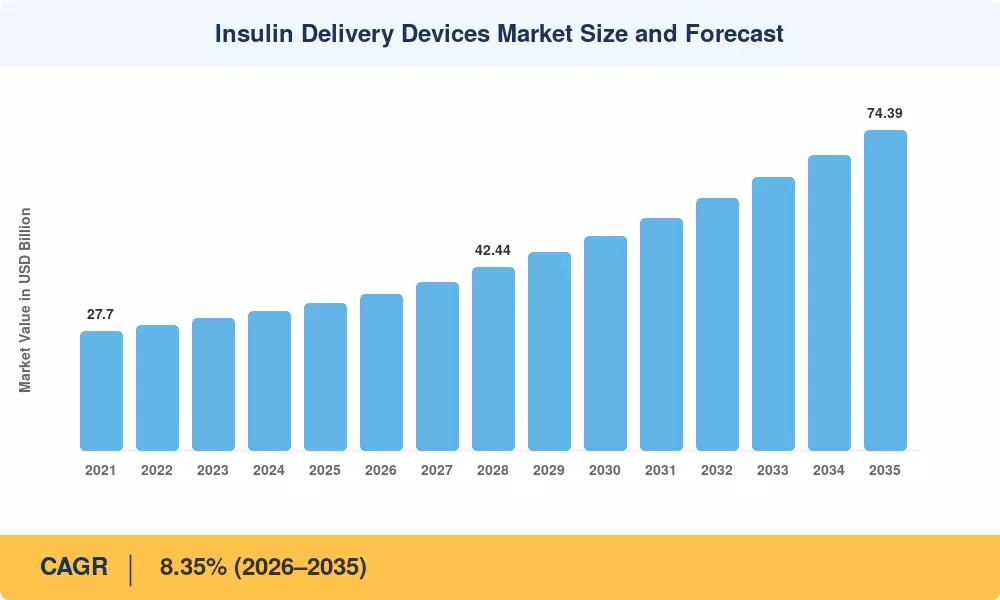
Insulin Delivery Devices Market Size
Insulin Delivery Devices Market to Surge from USD 36.15 Billion in 2026 to USD 74.39 Billion by 2035-By Rising Diabetes Prevalence, Reimbursement Expansion
NY, CA, UNITED STATES, August 11, 2026 /EINPresswire.com/ -- As per Market Research Future, the global Insulin Delivery Devices Market size is projected to reach USD 74.39 Billion by 2035 from USD 36.15 Billion in 2026, registering a CAGR of 8.35% during the forecast period 2026--2035. The market size was estimated at USD 34.15 Billion in 2025.The 8.35% CAGR is being supported by three converging forces: the expanding global diabetes population that creates sustained demand for insulin administration, broader reimbursement for wearable and automated delivery devices, and the technology shift from conventional injection hardware toward connected pens, patch pumps, hybrid automated delivery systems, and data-enabled platforms.
Request A Free Sample: https://www.marketresearchfuture.com/sample_request/851
Key Market Trends & Growth Drivers
Rising Global Diabetes Prevalence and Long-Term Insulin Dependence
The expanding diabetes population is creating a structural demand base for insulin delivery devices. The International Diabetes Federation projects that the number of adults living with diabetes will continue rising substantially over the coming decades. Type 1 diabetes requires lifelong insulin therapy, while a significant share of people with Type 2 diabetes eventually require insulin to maintain glycemic control. This broad patient base supports recurring demand for pens, syringes, pumps, infusion sets, and connected delivery platforms.
Growing diagnosis rates and longer life expectancy are also increasing the duration of diabetes management. As patients and clinicians seek more precise dosing, easier administration, and improved adherence, the market is shifting from basic injection products toward devices that combine convenience with monitoring and decision support. The increasing use of home-based diabetes care further reinforces demand for portable and self-management-oriented delivery systems.
Reimbursement Expansion for Wearable and Automated Devices
Reimbursement is becoming an important catalyst for advanced insulin delivery adoption. Expanded coverage for tubeless patch-style and wearable delivery systems lowers the financial barrier for patients who would otherwise rely on conventional pen and syringe routines. In mature healthcare markets, broader formulary inclusion and coverage codes are encouraging clinicians to consider automated and connected platforms for appropriate patient populations.
Emerging markets are also using public procurement to expand access. Government-supported purchasing can compress device prices while increasing volumes, creating a larger addressable population for pen and wearable platforms. As reimbursement frameworks increasingly recognize the value of improved glycemic outcomes and remote monitoring, the Insulin Delivery Devices Market is positioned to benefit from a gradual shift toward value-oriented device adoption.
Connected Devices and Automated Delivery Reshaping Diabetes Management
Legacy insulin delivery methods are increasingly being complemented by Bluetooth-enabled pens, connected pumps, tubeless patch systems, and hybrid automated delivery platforms. These devices can transmit glucose and dosing information to mobile applications and clinical systems, allowing patients and care teams to review trends and adjust treatment more efficiently.
Ask for Customization: https://www.marketresearchfuture.com/ask_for_customize/851
Market Segment Insights
BY PRODUCT TYPE
Pen-Based Devices: Dominant segment with approximately 48% revenue share in 2025. Broad retail availability, prescriber familiarity, portability, and ease of use continue to make reusable and disposable insulin pens the leading product category.
Insulin Pumps: Fastest-growing product category at a 12.4% CAGR through 2035. Tethered and tubeless pump platforms are benefiting from automated dosing algorithms, continuous glucose monitoring integration, and increasing pediatric adoption.
Insulin Syringes: Established and cost-sensitive segment with approximately USD 5.46 Billion in 2025. Syringes remain important in emerging economies and among patients seeking low-cost insulin administration.
Other Devices: Smaller but emerging category representing around 4% share in 2025, including inhalable and implantable approaches that can expand administration choices for selected patient groups.
BY TECHNOLOGY / CONNECTIVITY
Non-Connected Devices: Dominant technology category with approximately 66% revenue share in 2025. The installed base of conventional pens and syringes, lower costs, and limited switching incentives continue to support this segment.
Connected Devices: Fastest-growing technology category at a 13.8% CAGR through 2035. Bluetooth connectivity, real-time data sharing, remote monitoring, and payer incentives are accelerating adoption of connected pens and automated delivery platforms.
BY PATIENT AGE GROUP
Adults: Dominant segment with approximately 71% share in 2025. The larger population requiring insulin for Type 2 diabetes creates substantial demand for pens, syringes, and increasingly connected devices.
Pediatrics: Fastest-growing age segment at a 10.2% CAGR through 2035. Parents and clinicians are increasingly seeking automated systems that reduce manual dosing burden, improve monitoring, and support more consistent diabetes management for children.
BY DISTRIBUTION CHANNEL
Retail Pharmacies: Largest channel with approximately 41% share in 2025. Convenient access and pharmacist counseling support continued demand for pens, needles, and other routine delivery supplies.
Hospital Pharmacies: Generated approximately USD 8.53 Billion in 2025, supported by inpatient initiation protocols and hospital-based diabetes management.
BY END USER
Homecare: Dominant end-user segment with approximately 47% share in 2025. Most insulin therapy occurs outside clinical facilities, making portability, self-management, and remote monitoring important purchasing considerations.
Hospitals & Clinics: Generated approximately USD 11.26 Billion in 2025 and remain critical for inpatient glycemic management, device initiation, training, and complex cases.
Read Detailed Insights: https://www.marketresearchfuture.com/reports/insulin-delivery-devices-market-851
Regional Outlook
North America --- Dominant Market (~42% Share, 2025)
North America generated approximately 42% of global Insulin Delivery Devices Market revenue in 2025, supported by strong private payer coverage, high per-capita insulin expenditure, and established adoption of automated delivery platforms. The United States contributes the majority of regional demand as commercial and public payer formularies increasingly include advanced delivery technologies.
Reimbursement expansion for wearable systems and the growth of continuous glucose monitoring are strengthening the regional ecosystem. Canada is also expanding access through provincial formulary additions, while Mexico represents an opportunity as public health modernization improves access to diabetes-management technologies.
Europe --- Second Largest (~27% Share, 2025)
Europe represents the second-largest geographical market at approximately 27% of 2025 revenue. Demand is supported by statutory health insurance coverage, national diabetes programs, and growing adoption of connected devices. Germany, the UK, and France are important contributors, with healthcare systems increasingly incorporating digital and automated diabetes technologies.
Germany leads regional adoption through reimbursement pathways for connected devices, while the UK is growing at approximately 7.8% CAGR through 2035 as diabetes technology access expands under the NHS Long Term Plan. France contributes approximately USD 1.58 Billion in 2025, while Italy and Spain continue to benefit from digital-health integration and regional procurement programs.
Asia-Pacific --- Fastest-Growing Region (9.9% CAGR, 2026--2035)
Asia-Pacific is the fastest-growing regional market for insulin delivery devices, with an anticipated CAGR of 9.9% from 2026 to 2035. China and India are central to this expansion as government procurement, reimbursement initiatives, domestic manufacturing, and rising diabetes prevalence increase device adoption.
China accounts for approximately 38% of regional share, supported by the inclusion of domestically manufactured wearable platforms in government reimbursement programs. India is expanding at an estimated 11.2% CAGR as procurement programs and healthcare-access initiatives increase availability of insulin delivery technologies. Japan contributes approximately USD 1.42 Billion in 2025, while ASEAN markets are projected to grow at around 10.5% CAGR as insurance coverage and middle-class healthcare spending increase.
South America --- Growing Presence (USD 1.54 Billion, 2025)
South America generated approximately USD 1.54 Billion in 2025. Brazil anchors the region with around 58% of regional revenue, supported by public diabetes-care protocols and increasing access to reusable pen platforms. Argentina is projected to grow at approximately 7.5% CAGR through 2035 as public coverage expands.
Public health modernization and formulary inclusion are expected to support further adoption across the rest of South America. As healthcare systems expand access to diabetes technologies, demand is likely to shift gradually from basic injection supplies toward reusable and connected delivery solutions.
Middle East & Africa --- Emerging Opportunity (USD 1.19 Billion, 2025)
The Middle East & Africa represented approximately USD 1.19 Billion in 2025 and offers an expanding opportunity as diabetes prevalence rises and healthcare infrastructure improves. Saudi Arabia accounts for approximately 29% of regional share, supported by Vision 2030 healthcare investment and greater focus on chronic disease management.
The UAE is projected to grow at approximately 8.1% CAGR through 2035 as formulary modernization continues. South Africa contributes approximately USD 0.19 Billion in 2025, while Egypt and other markets are expanding access through national health programs and partnerships with healthcare organizations. Infrastructure development, affordability, and device availability remain key factors shaping the pace of adoption.
Competitive Landscape and Recent Developments
The Insulin Delivery Devices Market is highly concentrated, with the top five players projected to hold approximately 55--62% of global revenue. The competitive environment includes vertically integrated pharmaceutical-device companies, specialist insulin pump manufacturers, high-volume consumables suppliers, and technology-focused developers of automated dosing systems.
Competition is increasingly shifting beyond hardware specifications. Connectivity, algorithm performance, continuous glucose monitoring integration, interoperability, reimbursement access, and recurring consumables revenue are becoming major strategic differentiators. Companies are also strengthening ecosystem positions by combining insulin, devices, software, and patient-support services.
KEY COMPANIES AND RECENT MILESTONES
Novo Nordisk (2024--2025): Maintains a leading position through reusable and disposable pen systems and connected pen initiatives, supported by its vertically integrated insulin and device ecosystem. Estimated revenue share: ~14--18%.
Medtronic (2023--2025): Continued strengthening its hybrid automated delivery portfolio, including advanced meal-detection and dosing capabilities, reinforcing its position in pump platforms and CGM-integrated therapy. Estimated revenue share: ~12--16%.
Insulet Corporation (2022--2025): Expanded its tubeless pod-based delivery ecosystem and pediatric reach, supporting its position as a leading pure-play patch-pump company. Estimated revenue share: ~8--11%.
Future Outlook: 2026--2035
By the early 2030s, insulin delivery is expected to become increasingly software-defined. Hybrid automated systems will continue moving toward more autonomous dosing, while integration with continuous glucose monitoring, mobile applications, electronic health records, and telehealth platforms will create broader connected-care ecosystems.
Algorithm-driven autonomous dosing represents a major long-term opportunity. Next-generation closed-loop systems are expected to reduce the need for manual bolusing and improve time-in-range outcomes. As regulatory pathways mature and clinical evidence accumulates, premium pricing is likely to concentrate around platforms that provide higher levels of automation and personalization.
More Related Research Insights:
https://www.marketresearchfuture.com/reports/hyperbaric-oxygen-therapy-market-30668
https://www.marketresearchfuture.com/reports/schizophrenia-market-1625
https://www.marketresearchfuture.com/reports/medical-nutrition-market-1330
https://www.marketresearchfuture.com/reports/plasma-fractionation-market-7397
https://www.marketresearchfuture.com/reports/companion-diagnostic-market-3077
https://www.marketresearchfuture.com/reports/hospital-bed-market-898
https://www.marketresearchfuture.com/reports/poultry-vaccines-market-7515
https://www.marketresearchfuture.com/reports/medical-cannabis-market-8368
https://www.marketresearchfuture.com/reports/acupuncture-market-6139
https://www.marketresearchfuture.com/reports/point-of-care-molecular-diagnostics-market-11484
Larry Wilson
WantStats Research And Media Pvt. Ltd.
+1 855-661-4441
email us here
Visit us on social media:
LinkedIn
Facebook
YouTube
X
Legal Disclaimer:
EIN Presswire provides this news content "as is" without warranty of any kind. We do not accept any responsibility or liability for the accuracy, content, images, videos, licenses, completeness, legality, or reliability of the information contained in this article. If you have any complaints or copyright issues related to this article, kindly contact the author above.
