

Service Robotics Market to Reach USD 375.14 Billion by 2035 at a 17.8% CAGR
Service Robotics Market
Service Robotics Market Size, Share and Research Report By Field of Application (Professional, Personal / Domestic), By Component (Hardware, Software, Services)
Service Robotics Market: Growing exponentially across healthcare, hospitality, and logistics to automate routine labor, improve surgical precision, and solve labor shortages.”
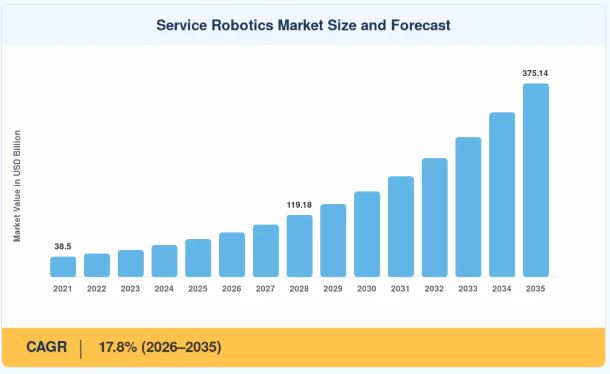
NEW YORK,, NY, UNITED STATES, August 10, 2026 /EINPresswire.com/ -- The Global service robotics market reached an estimated USD 72.90 billion in 2025 and is projected to grow from USD 85.88 billion in 2026 to USD 375.14 billion by 2035, registering a CAGR of 17.8% during the forecast period. Two major catalysts are accelerating this trajectory: the acute labor shortages across healthcare, logistics, and hospitality sectors that are compelling enterprises to automate previously human-only tasks, and the rapid maturation of AI-powered perception, navigation, and manipulation technologies that have dramatically expanded the operational envelope of autonomous robots. With over 4.2 million service robots expected to be deployed annually by 2030, organizations face mounting pressure to integrate robotic automation or cede efficiency and cost advantages to early-moving competitors.— Market Research Future (MRFR)
Legacy fixed-function automation systems many designed for controlled factory environments with limited sensing capability are rapidly giving way to collaborative, mobile service robots that integrate computer vision, simultaneous localization and mapping (SLAM), natural language interfaces, and cloud-connected fleet intelligence. A recent McKinsey Global Institute analysis estimated that organizations deploying autonomous mobile robots (AMRs) in warehouse and fulfillment operations achieved 30–40% reductions in order cycle times alongside 20–25% decreases in labor-related operational costs compared to non-automated peers. This technology shift is not incremental it represents a fundamental restructuring of how industries staff, operate, and scale their service delivery models.
Get Full PDF Sample Copy of Report: (Including Full TOC, List of Tables & Figures, Chart) @
https://www.marketresearchfuture.com/sample_request/2437
➤ How Significant Is the Service Robotics Market’s Growth?
The service robotics market has demonstrated exceptional and sustained expansion, rising from approximately USD 25.4 billion in 2021 to an estimated USD 46.8 billion in 2025, representing a powerful historical growth trajectory. The market is expected to nearly quadruple over the next decade, driven by converging forces: accelerating AI capabilities, declining hardware costs, expanding connectivity infrastructure, and demographic pressures that are making human labor increasingly scarce and expensive across key service sectors.
Surging deployment of surgical assistance robots in hospitals, autonomous delivery systems in logistics networks, floor-cleaning and disinfection robots in commercial facilities, and agricultural harvesting robots in food production has created acute demand for versatile, intelligent robotic platforms. Healthcare systems, third-party logistics providers, hotel chains, retail operators, and public infrastructure managers are all investing heavily in service robotics to address workforce gaps, improve service consistency, and unlock operational efficiencies previously unattainable through human-only models.
➤ What Does the Future Hold for the Service Robotics Market?
Artificial intelligence and autonomy stand at the forefront of the market’s next growth phase. Next-generation service robots are transforming from programmed task-executors into adaptive, learning systems capable of navigating unstructured environments, collaborating safely with humans, and continuously improving their performance through operational data feedback loops. Foundation models for robotics analogous to large language models in the AI space are beginning to enable general-purpose robotic systems that can be rapidly re-tasked across diverse service contexts without costly re-programming.
The growing emphasis on human-robot collaboration (HRC) is another defining force shaping the market’s future. Rather than replacing humans entirely, the most commercially successful deployments integrate cobots and autonomous mobile systems into workflows where they handle repetitive, high-frequency, or physically demanding tasks freeing human workers for higher-value decision-making, customer interaction, and exception handling. This HRC model is proving particularly powerful in healthcare, where surgical robots, rehabilitation systems, and patient-monitoring platforms augment clinical staff rather than displace them.
Robot-as-a-Service (RaaS) subscription models are also fundamentally redefining the economics of service robotics adoption. By shifting capital expenditure to operational expenditure, RaaS platforms are enabling small and mid-size enterprises previously priced out of enterprise robotics to access cutting-edge autonomous systems at accessible monthly rates, dramatically expanding the addressable market across hospitality, retail, and facility management verticals.
Direct Purchase this Research Report:
https://www.marketresearchfuture.com/checkout?currency=one_user-USD&report_id=2437
➤ Who Are the Key Players in the Service Robotics Market?
The service robotics landscape is characterized by a dynamic mix of established industrial automation giants, specialized medical robotics companies, agile logistics-focused startups, and diversified technology conglomerates. Key participants shaping the competitive dynamics include:
Intuitive Surgical — commanding the surgical robotics segment with its da Vinci platform, which has supported over 10 million procedures globally across minimally invasive surgery applications
Boston Dynamics — pioneering advanced mobile manipulation with Spot, Stretch, and Atlas platforms deployed across industrial inspection, logistics, and research applications
ABB Ltd. — delivering collaborative robot arms and autonomous mobile systems for manufacturing support, logistics, and healthcare facility operations
KUKA AG — offering versatile cobot and service robot platforms spanning healthcare assistance, food handling, and facility automation across global markets
iRobot Corporation — dominating the consumer robotic vacuum segment while expanding into commercial floor-care and connected home assistance applications
Ecovacs Robotics — serving the consumer and light-commercial cleaning robot market with AI-powered floor care, window-cleaning, and lawn-mowing platforms
Savioke — specializing in autonomous delivery robots purpose-built for hotel, hospital, and senior living facility service environments
Aethon (Swisslog Healthcare) — providing autonomous mobile robot platforms for hospital logistics including medication delivery, linen transport, and supply chain automation
Locus Robotics — deploying collaborative AMR systems for e-commerce and third-party logistics fulfillment operations at scale
Starship Technologies — operating autonomous last-mile delivery robot fleets across university campuses and suburban communities in multiple countries
Competition in the market is intensifying as vendors race to embed generative AI and foundation model capabilities into their robotic platforms, expand RaaS subscription offerings to lower adoption barriers, and forge strategic partnerships with cloud hyperscalers, healthcare systems, and third-party logistics providers. Mergers and acquisitions activity is also reshaping the landscape as established industrial automation players seek to acquire AI-native robotics startups to accelerate their autonomous capability roadmaps.
➤ What Are the Emerging Trends in the Service Robotics Market?
Several transformational trends are redefining how the service robotics market evolves through 2035:
AI Foundation Models for Robotics: General-purpose robotic intelligence trained on massive multi-modal datasets is beginning to enable rapid task adaptation, reducing deployment and re-tasking timelines from months to days and fundamentally lowering the cost of scaling robotic fleets across diverse service environments.
Robot-as-a-Service (RaaS) Proliferation: Subscription-based deployment models are democratizing access to enterprise-grade service robots for SMEs across hospitality, retail, and facilities management, unlocking substantial new addressable market segments previously inaccessible due to high capital costs.
Surgical and Medical Robotics Expansion: Beyond established surgical assistance platforms, new categories including endoscopic robots, rehabilitation exoskeletons, medication dispensing systems, and AI-guided diagnostic robots are emerging as high-growth subsegments within healthcare robotics.
Autonomous Last-Mile Delivery: Sidewalk delivery robots and drone-based autonomous delivery systems are gaining regulatory clearance across multiple jurisdictions, creating a rapidly expanding commercial deployment opportunity for logistics and e-commerce operators seeking to address final-mile cost pressures.
Multi-Robot Fleet Orchestration: Advanced fleet management software enabling coordinated operation of hundreds of heterogeneous robots across complex facility environments is becoming a critical differentiator, with AI-powered task allocation and dynamic traffic management driving step-change efficiency gains.
Agricultural and Food Production Robotics: Harvest automation, precision spraying, crop monitoring drones, and autonomous greenhouse management robots are addressing severe agricultural labor shortages while enabling the precision farming practices essential for sustainable global food production at scale.
Get access to the full description of the report @
https://www.marketresearchfuture.com/reports/service-robotics-market-2437
➤ How Is the Service Robotics Market Segmented?
The service robotics market report provides a comprehensive segmentation framework:
1 By Type: Professional Service Robots, Personal & Domestic Service Robots
2 By Mobility: Stationary, Wheeled Mobile, Legged, Aerial (Drones), Aquatic
3 By End-Use Vertical: Healthcare & Medical, Logistics & Warehousing, Agriculture & Farming, Hospitality & Retail, Defense & Security, Domestic & Consumer, Public Infrastructure
4 By Deployment Model: Robot-as-a-Service (RaaS), Outright Purchase, Leasing
5 By Organization Size: SMEs, Large Enterprises, Government & Public Sector
➤ What Are the Regional Insights from the Service Robotics Market?
North America commands approximately 38% of global service robotics market share, underpinned by the region’s world-leading surgical robotics adoption, extensive e-commerce fulfillment automation investments, and a robust venture capital ecosystem that has funded a generation of AI-native robotics startups. The United States’ acute nursing and care worker shortages projected to reach 3.2 million healthcare workers by 2026 are creating particular urgency for healthcare service robotics deployment across hospital systems and senior care facilities.
Europe holds the second-largest share at approximately 25%, with Germany, the United Kingdom, and the Netherlands representing the primary markets. Europe’s strong industrial automation heritage, combined with pressing demographic challenges in healthcare and eldercare, is driving sustained investment in professional service robots. The EU AI Act and emerging robotics safety standards are compelling vendors to develop explainable, auditable robotic systems creating compliance-driven technology differentiation opportunities.
Asia-Pacific represents the fastest-growing major region, fueled by Japan’s acute eldercare robotics demand driven by its super-aged population, China’s massive government-backed robotics manufacturing and deployment initiatives, and South Korea’s advanced robot density across both industrial and service applications. The region’s combination of technology manufacturing scale and favorable regulatory environments for public-space robot deployment is expected to sustain above-average growth through 2035.
Middle East & Africa is projected to register a CAGR of approximately 15.4% through 2035 the highest of any region. Landmark smart city projects in Saudi Arabia and the UAE, alongside rapid expansion of automated logistics infrastructure across Gulf Cooperation Council economies, are generating substantial demand for service robots across hospitality, security, and last-mile delivery applications.
South America and South Asia round out the global picture, with Brazil, India, and Mexico representing the most active emerging markets for service robotics adoption, particularly in agricultural automation, logistics, and healthcare applications where labor cost pressures and infrastructure modernization initiatives are converging to drive accelerated adoption.
➤➤➤ Industry Analysis Reports by Market Research Future:
Interactive Table Market-
https://www.marketresearchfuture.com/reports/interactive-table-market-33807
Surface Mount Switch Market-
https://www.marketresearchfuture.com/reports/surface-mount-switch-market-33910
Surplus Lines Insurance Market-
https://www.marketresearchfuture.com/reports/surplus-lines-insurance-market-33917
Patch Cable Market-
https://www.marketresearchfuture.com/reports/patch-cable-market-33935
System In Package Sip Market-
https://www.marketresearchfuture.com/reports/system-in-package-sip-market-33954
Oxygen Flow Meter Market-
https://www.marketresearchfuture.com/reports/oxygen-flow-meter-market-33965
Inkjet Coder Market-
https://www.marketresearchfuture.com/reports/inkjet-coder-market-33969
Tank Level Monitoring System Market-
https://www.marketresearchfuture.com/reports/tank-level-monitoring-system-market-33973
Intelligent Building Management System Market-
https://www.marketresearchfuture.com/reports/intelligent-building-management-system-market-33974
Opto Semiconductor Market-
https://www.marketresearchfuture.com/reports/opto-semiconductor-market-33987
Sagar Kadam
Market Research Future
+ +1 628-258-0071
email us here
Legal Disclaimer:
EIN Presswire provides this news content "as is" without warranty of any kind. We do not accept any responsibility or liability for the accuracy, content, images, videos, licenses, completeness, legality, or reliability of the information contained in this article. If you have any complaints or copyright issues related to this article, kindly contact the author above.
