

Healthcare IoT Market to Reach US$ 523.1 Billion by 2033, Growing at a CAGR of 21.3% from 2026–2033
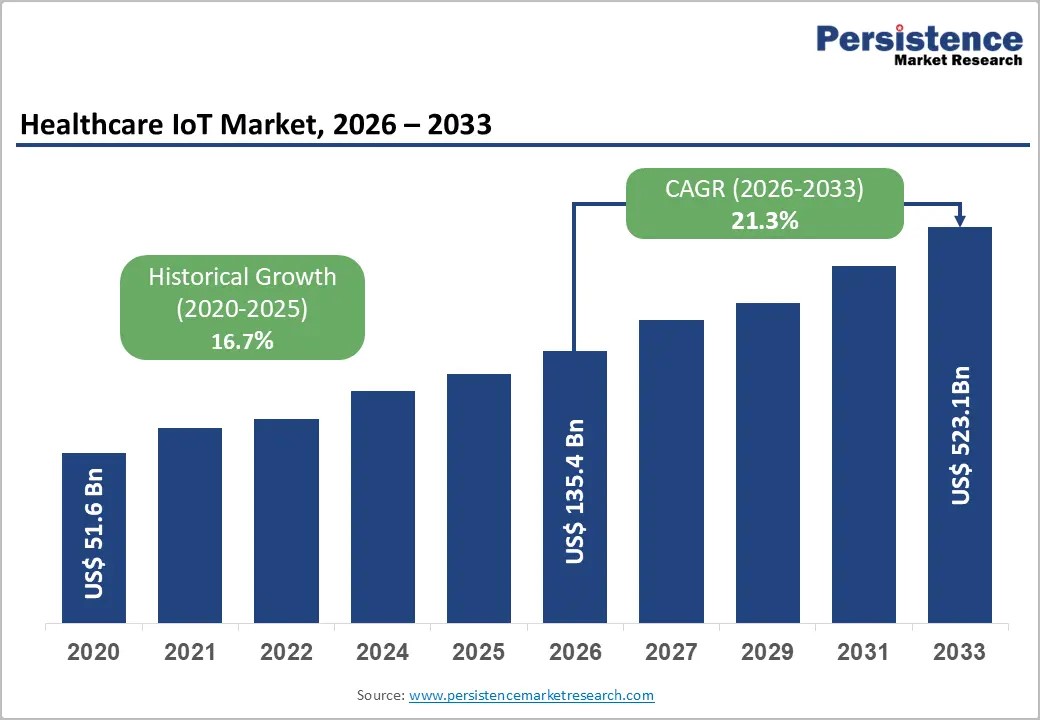
The Healthcare IoT Market is projected to grow from US$ 135.4 Bn in 2026 to US$ 523.1 Bn by 2033, at a CAGR of 21.3%, driven by smart healthcare adoption
BRENTFORD, ENGLAND, UNITED KINGDOM, June 2, 2026 /EINPresswire.com/ -- The global Healthcare IoT Market is experiencing unprecedented growth as healthcare providers increasingly adopt connected medical devices, wearable technologies, smart sensors, and cloud-based healthcare platforms to improve patient care and operational efficiency. The market was valued at US$ 135.4 billion in 2026 and is projected to reach US$ 523.1 billion by 2033, expanding at a remarkable CAGR of 21.3% during the forecast period. This growth reflects the accelerating integration of Internet of Things (IoT) technologies into healthcare ecosystems, enabling real-time patient monitoring, predictive analytics, and remote healthcare delivery. Rising prevalence of chronic diseases, growing aging populations, increasing demand for personalized healthcare, and rapid digital transformation across healthcare institutions are among the primary factors fueling market expansion.
Healthcare organizations worldwide are investing heavily in digital health infrastructure to improve care delivery while reducing operational costs. Government initiatives supporting connected healthcare, advancements in 5G connectivity, artificial intelligence integration, and cloud computing technologies are creating a favorable environment for Healthcare IoT adoption. The hardware segment currently dominates the market with approximately 55% share due to widespread deployment of wearable devices, implantable sensors, and monitoring systems. Geographically, North America leads the global Healthcare IoT Market with around 35% market share, supported by advanced healthcare infrastructure, high technology adoption rates, and favorable reimbursement policies. Meanwhile, East Asia is emerging as the fastest-growing regional market due to rapid healthcare modernization and government-backed digital health initiatives.
𝐆𝐞𝐭 𝐚 𝐒𝐚𝐦𝐩𝐥𝐞 𝐏𝐃𝐅 𝐁𝐫𝐨𝐜𝐡𝐮𝐫𝐞 𝐨𝐟 𝐭𝐡𝐞 𝐑𝐞𝐩𝐨𝐫𝐭: https://www.persistencemarketresearch.com/samples/31698
Market Segmentation
The Healthcare IoT Market is segmented by component type, connectivity technology, and end users. Hardware dominates the market due to the growing adoption of wearable devices, smart sensors, implantable devices, and patient monitoring systems. Software and services are also expanding rapidly as healthcare providers increasingly rely on cloud-based platforms, analytics solutions, and remote monitoring applications.
By connectivity, Wi-Fi leads the market owing to its widespread use across healthcare facilities, while Bluetooth Low Energy (BLE) is the fastest-growing segment due to its popularity in wearables and remote monitoring devices. Based on end users, hospitals and clinics account for the largest share, while ambulatory care centers are emerging as the fastest-growing segment due to the shift toward outpatient care and digital health services.
Regional Insights
North America leads the Healthcare IoT Market, supported by advanced healthcare infrastructure, strong digital health adoption, and favorable reimbursement policies. Europe holds a significant share due to increasing healthcare digitalization and supportive regulatory initiatives such as the European Health Data Space.
East Asia is the fastest-growing region, driven by healthcare modernization programs in China, Japan, and South Korea. Meanwhile, Latin America, the Middle East, and Africa are witnessing increasing investments in telemedicine and connected healthcare technologies, supporting future market growth.
𝐃𝐨 𝐘𝐨𝐮 𝐇𝐚𝐯𝐞 𝐀𝐧𝐲 𝐐𝐮𝐞𝐫𝐲 𝐎𝐫 𝐒𝐩𝐞𝐜𝐢𝐟𝐢𝐜 𝐑𝐞𝐪𝐮𝐢𝐫𝐞𝐦𝐞𝐧𝐭? 𝐑𝐞𝐪𝐮𝐞𝐬𝐭 𝐂𝐮𝐬𝐭𝐨𝐦𝐢𝐳𝐚𝐭𝐢𝐨𝐧 𝐨𝐟 𝐑𝐞𝐩𝐨𝐫𝐭: https://www.persistencemarketresearch.com/request-customization/31698
Market Drivers
Government support for digital health infrastructure and favorable healthcare policies are major drivers of market growth. Initiatives such as the FDA's digital health programs, India's Ayushman Bharat Digital Mission, and European digital health frameworks are accelerating Healthcare IoT adoption.
The rapid deployment of 5G networks is further boosting the market by enabling real-time patient monitoring, telemedicine, and AI-powered healthcare applications. Growing chronic disease prevalence and aging populations also continue to drive demand for connected healthcare solutions.
Market Restraints
High implementation and maintenance costs remain key challenges for Healthcare IoT adoption, particularly among smaller healthcare providers. Investments in devices, cybersecurity, cloud infrastructure, and staff training increase the total cost of deployment.
Additionally, integration issues with legacy healthcare systems and concerns related to data privacy and cybersecurity create barriers to widespread adoption.
Market Opportunities
The integration of artificial intelligence with Healthcare IoT platforms presents significant opportunities by enabling predictive analytics, early disease detection, and personalized treatment planning. AI-powered insights can improve patient outcomes while reducing healthcare costs.
The growing adoption of ambulatory care centers and outpatient healthcare services also creates substantial growth opportunities. Increasing demand for remote monitoring, connected diagnostics, and value-based care models is expected to drive long-term market expansion.
𝐁𝐮𝐲 𝐍𝐨𝐰 𝐭𝐡𝐞 𝐃𝐞𝐭𝐚𝐢𝐥𝐞𝐝 𝐑𝐞𝐩𝐨𝐫𝐭: https://www.persistencemarketresearch.com/checkout/31698
Company Insights
Key Players Operating in the Healthcare IoT Market
• Medtronic
• Cisco Systems, Inc.
• IBM Corporation
• GE Healthcare
• Microsoft Corporation
• SAP SE
• Infosys Limited
• Cerner Corporation
• QUALCOMM Incorporated
• Amazon
• Intel Corporation
• Wipro Ltd
Recent Developments
In June 2024, TE Connectivity expanded its healthcare-focused IoT sensor portfolio by introducing advanced miniaturized sensors and connectivity technologies designed to improve medical device reliability and remote patient monitoring capabilities.
In October 2024, Siemens implemented a customized IoT-powered smart hospital platform at Kantonsspital Baden in Switzerland. The platform integrates over 7,000 IoT sensors and 2,000 smart asset tags, enabling real-time asset tracking, operational optimization, and enhanced patient experiences.
Conclusion
The global Healthcare IoT Market is undergoing transformative growth driven by rapid advancements in connected healthcare technologies, government-backed digital health initiatives, expanding 5G infrastructure, and increasing adoption of artificial intelligence. The ability of IoT solutions to enable real-time patient monitoring, predictive analytics, remote care delivery, and operational optimization is reshaping healthcare systems worldwide. While challenges related to implementation costs, interoperability, and cybersecurity remain, continued technological innovation and favorable regulatory support are expected to accelerate adoption. With North America maintaining market leadership and East Asia emerging as the fastest-growing region, the Healthcare IoT Market is well positioned for sustained expansion through 2033, creating significant opportunities for healthcare providers, technology companies, and investors alike.
Related Reports:
Parental Control Software Market
Pooja Gawai
Persistence Market Research
+1 646-878-6329
email us here
Visit us on social media:
LinkedIn
Instagram
Facebook
YouTube
X
Legal Disclaimer:
EIN Presswire provides this news content "as is" without warranty of any kind. We do not accept any responsibility or liability for the accuracy, content, images, videos, licenses, completeness, legality, or reliability of the information contained in this article. If you have any complaints or copyright issues related to this article, kindly contact the author above.
