

Clinical Drug Supply Chain Services Market: Hit USD 24 Bn by 2036, Fueled by Surge in Late-Phase Biologics Trials | FMI
Clinical Drug Supply Chain Services Market
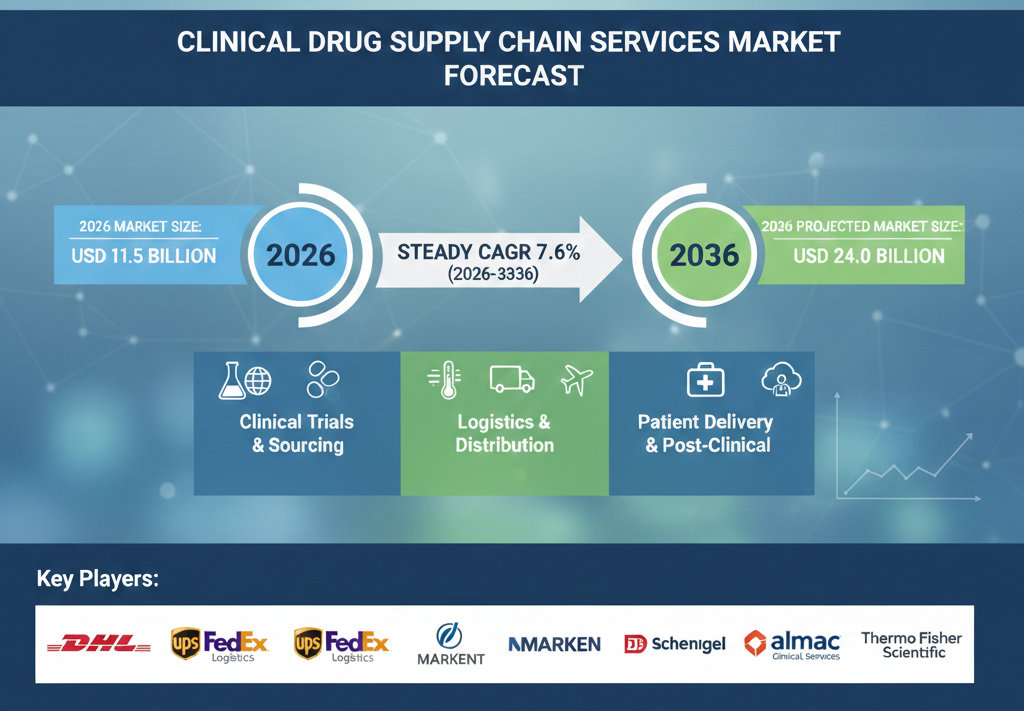
Future Market Insights anticipates the global clinical drug supply chain services market to expand from USD 11.5 billion in 2026 to USD 24.0 billion by 2036
NEW YORK, DE, UNITED STATES, February 11, 2026 /EINPresswire.com/ -- The global clinical drug supply chain services market is entering a structurally integrated phase, evolving from transactional logistics support to critical operational infrastructure for global clinical development, according to the latest outlook by Future Market Insights (FMI). The market is projected to expand from USD 11.5 billion in 2026 to USD 24.0 billion by 2036, registering a CAGR of 7.6% during the forecast period.
FMI analysis indicates that rising Phase II and Phase III trial volumes, expanding biologics and advanced therapy pipelines, and increasing globalization of clinical programs are fundamentally redefining supply chain execution requirements. Late-phase studies are generating demand for scalable depot networks, temperature-qualified distribution, and documentation-intensive chain-of-custody management capable of supporting large patient populations and adaptive protocols. Clinical supply chain services are increasingly viewed not as transport solutions, but as risk-mitigating continuity frameworks embedded directly into trial design.
Market Overview: Who, What, Why, and How
• Who: Pharmaceutical and biopharmaceutical sponsors, CROs, CDMOs/CMOs, academic institutions, and specialized clinical logistics providers.
• What: End-to-end planning, storage, handling, packaging, and distribution of investigational medicinal products (IMPs).
• When: 2026–2036, with late-phase trial density driving peak demand.
• Where: United States leading, followed by India, China, UK, Germany, and Japan.
• Why: Biologics growth, decentralized trials, tightening GDP compliance, and expanding multinational trial footprints.
• How: Through integrated depot infrastructure, validated cold chain networks, direct-to-patient models, and digital visibility platforms.
FMI concludes that clinical drug supply chain services are transitioning from service vendors to embedded operational partners responsible for regulatory integrity and patient safety continuity.
Request For Sample Report | Customize Report | Purchase Full Report - https://www.futuremarketinsights.com/reports/sample/rep-gb-31893
Key Market Metrics (2026–2036)
• Industry Size (2026): USD 11.5 Billion
• Industry Value (2036): USD 24.0 Billion
• CAGR (2026–2036): 7.6%
• Growth Character: Late-phase intensive and biologics-driven
Executive-Level Insights
• Phase III trials anchor service demand.
• Biologics complexity is redefining temperature logistics.
• Decentralized trials require patient-centric delivery models.
• Regulatory scrutiny is elevating documentation rigor.
• Digital platforms are shifting logistics from transport to orchestration.
Structural Shift: From Transactional Logistics to Integrated Orchestration
Clinical trial logistics is becoming increasingly complex due to:
• Multi-temperature protocols within single studies
• Biologic and cell & gene therapy (CGT) handling requirements
• Decentralized and hybrid trial models
• Increased regulatory audit scrutiny
Studies frequently require simultaneous handling across ambient/CRT, 2–8°C, frozen (-20°C), ultra-cold (-70°C), and cryogenic (LN2) temperature bands. This multidimensional complexity is increasing reliance on partners with validated cold chain execution, multimodal transport coordination, and audit-ready documentation systems. Large service providers are expanding GMP-aligned depot capacity, enhancing temperature-qualified packaging expertise, and improving last-mile precision. Leadership across global logistics firms emphasizes resilience, end-to-end visibility, and real-time monitoring as essential to preserving trial integrity in distributed global studies.
Segment Highlights: Where Demand Is Concentrated
By Clinical Phase
• Phase III: 45.0% share of total service demand
• Phase II
• Phase I
• Phase IV / RWE
Phase III trials dominate due to high patient volume, complex resupply cycles, multi-country execution, and heightened regulatory risk. Sponsors increasingly rely on expert supply partners to mitigate discontinuity risk and maintain inspection readiness.
By Temperature Band
• Ambient / Controlled Room Temperature (CRT): 40.0% share
• 2–8°C (Refrigerated)
• Frozen (-20°C)
• Ultra-cold (-70°C)
• Cryogenic (LN2)
Ambient and CRT remain dominant due to the prevalence of small molecule trials. However, biologics expansion is accelerating growth in refrigerated and ultra-cold segments.
By Service Type
• Depot & Warehousing
• Cold-Chain Logistics
• Comparator Sourcing
• Packaging & Labeling
• Distribution & Transportation
• Direct-to-Patient Delivery
• Returns & Destruction
Country-Level Growth Outlook
Countries driving expansion through 2036 include:
• India: 9.1% CAGR
• China: 8.4%
• United States: 7.2%
• United Kingdom: 6.8%
• Germany: 6.3%
• Japan: 5.9%
The United States leads in absolute market share due to high trial density and biologics development. India and China represent the fastest-growing markets driven by outsourcing expansion and cold-chain capacity scale-up. Germany and Japan maintain premium, compliance-driven service demand supported by regulatory rigor.
Digitalization and Operational Innovation
Clinical supply chain services are increasingly supported by:
• Real-time temperature monitoring sensors
• Analytics-driven forecasting and inventory optimization
• Digital chain-of-custody tracking
• Risk-based planning models
• Multimodal route optimization
Key players include:
• DHL Supply Chain
• UPS Healthcare
• FedEx Logistics
• World Courier (Cencora)
• Marken (UPS)
• Kuehne+Nagel
• DB Schenker
• Catalent
• Almac Clinical Services
• Thermo Fisher Scientific
Recent strategic activity includes acquisitions to enhance final-mile healthcare delivery, platform mergers to integrate commercialization and patient access capabilities, and expanded cold-chain infrastructure to support specialty pharma growth.
Differentiation through 2036 will depend on:
• Temperature-band mastery
• Late-phase execution precision
• Integrated packaging and labeling infrastructure
• Digital visibility and documentation rigor
• Customer-type customization
Outlook Through 2036
Future Market Insights concludes that clinical drug supply chain services are becoming foundational infrastructure within global drug development ecosystems.
Through 2036, market expansion will be defined by:
• Increasing biologics and CGT handling complexity
• Globalized multi-country trial execution
• Expansion of GMP-aligned depot networks
• Enhanced cold-chain visibility systems
• Integrated, bundled service offerings
As sponsors and CROs prioritize continuity, compliance, and patient safety across distributed trials, clinical drug supply chain services will continue transitioning from logistical support to strategic operational backbone positioning the market for sustained mid-to-high single-digit growth over the coming decade.
Why FMI: https://www.futuremarketinsights.com/why-fmi
Have a Look at Related Research Reports on the Packaging Domain:
Packaging Foam Market: https://www.futuremarketinsights.com/reports/packaging-foam-market
Smart Food Packaging Market: https://www.futuremarketinsights.com/reports/smart-food-packaging-market
Packaging Jar Market: https://www.futuremarketinsights.com/reports/packaging-jars-market
About Future Market Insights (FMI)
Future Market Insights, Inc. (FMI) is an ESOMAR-certified, ISO 9001:2015 market research and consulting organization, trusted by Fortune 500 clients and global enterprises. With operations in the U.S., UK, India, and Dubai, FMI provides data-backed insights and strategic intelligence across 30+ industries and 1200 markets worldwide.
Sudip Saha
Future Market Insights Inc.
+1 347-918-3531
email us here
Legal Disclaimer:
EIN Presswire provides this news content "as is" without warranty of any kind. We do not accept any responsibility or liability for the accuracy, content, images, videos, licenses, completeness, legality, or reliability of the information contained in this article. If you have any complaints or copyright issues related to this article, kindly contact the author above.
