

Global Conveyor Belts Market to Grow from USD 4.47 Billion in 2026 to USD 6.62 Billion by 2036 at CAGR 4.0%
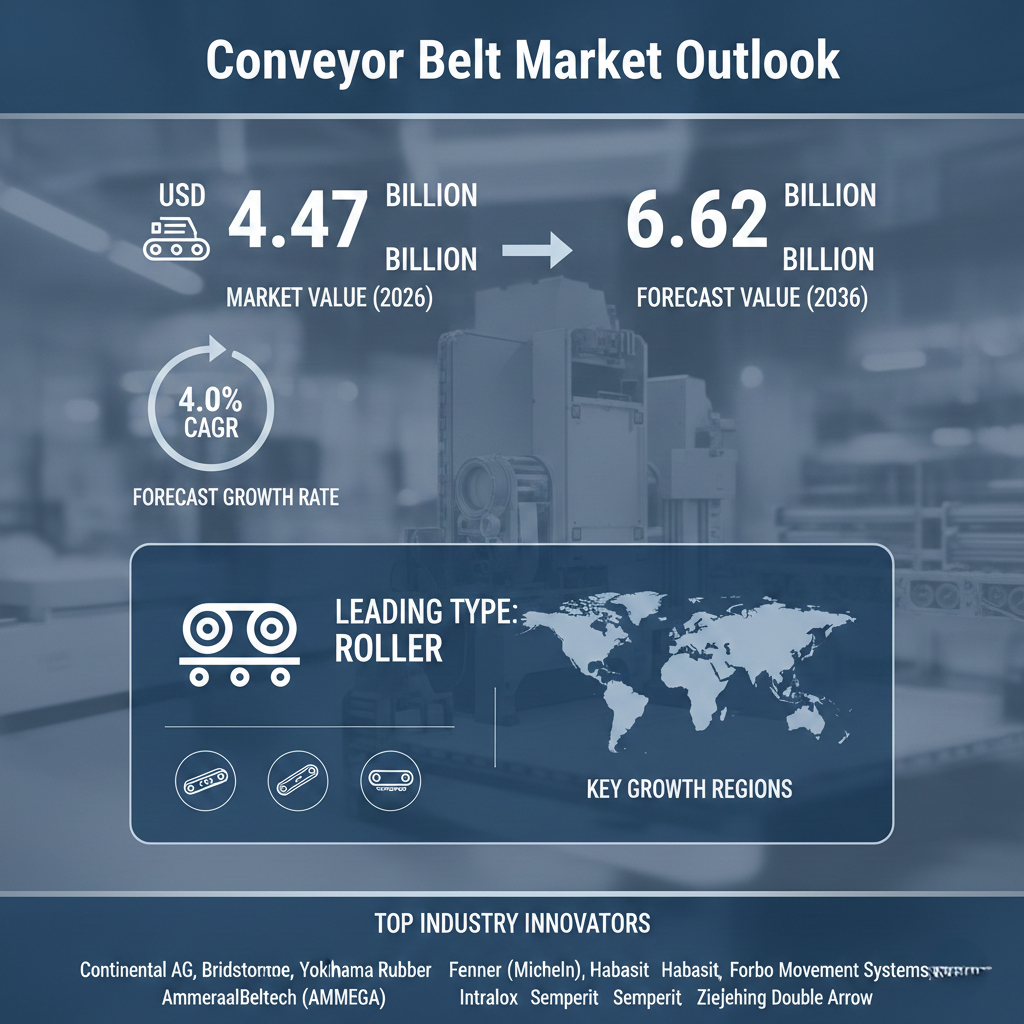
Market expands steadily as automation, mining, logistics, and smart conveyor technologies drive demand globally.
NEWARK, DE, UNITED STATES, January 28, 2026 /EINPresswire.com/ -- The global conveyor belt market is projected to expand significantly over the next decade, driven by rising demand for automated material handling systems across manufacturing, mining, logistics, and distribution sectors. According to a comprehensive market analysis, the industry is forecast to grow from its 2026 valuation of USD 4.47 billion to USD 6.62 billion by 2036 at a compound annual growth rate (CAGR) of 4.0 %.
Conveyor belts, essential components of industrial transport and logistics infrastructure, are key to supporting the global shift toward productivity, throughput optimization, and sustainable operations. This growth underscores broad adoption across facilities, supply chains, and automated systems worldwide.
Who Is Driving Market Expansion?
The conveyor belt market’s expansion is powered by manufacturers, logistics operators, mining firms, and automated distribution centers seeking efficient, cost-effective material movement. Growth is particularly strong in regions with fast-expanding industrial bases and logistics networks, including Asia Pacific, North America, and Europe.
In Asia Pacific, large markets such as China and India are investing heavily in warehouse automation, manufacturing modernization, and infrastructure upgrades — making them major contributors to global demand.
What Is the Market Outlook?
Future market forecasts indicate steady global demand for conveyor belt systems. The industry’s 2026 base value of USD 4.47 billion is set to rise to USD 6.62 billion by 2036, with a CAGR of 4.0 % over that period.
Lightweight conveyor belts account for a significant share of market demand due to their advantages in energy efficiency, speed, and adaptability, particularly in e-commerce, parcel hubs, and automated sorting facilities.
When and Where Will Growth Occur?
The forecast period — 2026 through 2036 — covers a sustained phase of industrial digital transformation. Conveyor belts will be increasingly deployed in smart factories, automated warehouses, ports, and bulk terminals to support continuous material flow with enhanced reliability and performance.
Regionally, Asia-Pacific remains a growth leader, bolstered by rapid industrialization, logistics infrastructure investment, and e-commerce penetration. North America and Europe also show stable adoption as manufacturing and logistics firms upgrade systems for efficiency and competitive performance.
Why Is This Market Growing?
Automation Trends: Conveyor belts are fundamental to material handling and automated workflows, enabling faster throughput and reduced manual labor. Their integration with sensors and monitoring systems supports predictive maintenance and real-time operational visibility.
E-Commerce & Logistics Expansion: Continued expansion of e-commerce and third-party logistics operations elevates demand for automated systems that can support high-speed sorting, routing, and distribution.
Industrial Modernization: Manufacturing facilities across sectors — automotive, food and beverage, pharmaceuticals, and electronics — are prioritizing conveyor belts to improve productivity, safety, and operational continuity.
Mining & Bulk Handling: Conveyor belts are critical to mining and bulk-material transport operations, where they deliver persistent performance under heavy loads over long distances.
How Is the Market Structured?
The conveyor belt market is segmented across product type, belt classification, material composition, installation type, application, and geography:
• Product Types: Roller, floor, overhead, pallet, and crescent conveyors serve a wide range of industrial logistics needs.
• Belt Classification: Lightweight, medium-weight, and heavyweight belts address demands from high-speed parcel lines to heavy bulk-material transport.
• Materials: Polymers and metal-reinforced belts deliver varying performance profiles for different operational contexts.
• Applications: Industrial manufacturing, food processing, retail logistics, airport systems, and automotive assembly all represent major end-use segments.
Challenges and Market Dynamics
Despite robust demand, the conveyor belt market faces notable challenges. High installation and integration costs, raw material price fluctuations, and periodic maintenance requirements can limit adoption, especially among smaller enterprises.
Additionally, legacy infrastructure compatibility issues and the need for technical expertise in deploying advanced systems create operational barriers.
Nonetheless, innovations in smart monitoring, modular design, lightweight materials, and energy-efficient systems are transforming conveyor belts from static tools into critical components of intelligent supply chains and automated production lines.
Industry Significance and Forward Focus
As global supply chains evolve, conveyor belts will remain foundational to modern logistics and production ecosystems. Their role spans warehouse automation, manufacturing floors, mining projects, and distribution hubs — reflecting broader industrial trends toward efficiency, resilience, and digital integration.
With sustained expansion projected over the next decade, the conveyor belt market offers visibility into industrial priorities for material handling performance, technology integration, and operational optimization worldwide.
Request for Sample Report | Customize Report |purchase Full Report – https://www.futuremarketinsights.com/reports/sample/rep-gb-319
Explore More Related Studies Published by FMI Research:
Pharmaceutical Solvents Market https://www.futuremarketinsights.com/reports/pharmaceutical-solvents-market
Environmental Remediation Technology Market https://www.futuremarketinsights.com/reports/environmental-remediation-technology-market
Ferrous Sulfate Market https://www.futuremarketinsights.com/reports/ferrous-sulfate-market
About Future Market Insights (FMI)
Future Market Insights, Inc. (FMI) is an ESOMAR-certified, ISO 9001:2015 market research and consulting organization, trusted by Fortune 500 clients and global enterprises. With operations in the U.S., UK, India, and Dubai, FMI provides data-backed insights and strategic intelligence across 30+ industries and 1200 markets worldwide.
Why Choose FMI: https://www.futuremarketinsights.com/why-fmi
Sudip Saha
Future Market Insights Inc.
+1 347-918-3531
rahul.singh@futuremarketinsights.com
Legal Disclaimer:
EIN Presswire provides this news content "as is" without warranty of any kind. We do not accept any responsibility or liability for the accuracy, content, images, videos, licenses, completeness, legality, or reliability of the information contained in this article. If you have any complaints or copyright issues related to this article, kindly contact the author above.
